Probability Models from Pascal and Fermat's Correspondence and Their Role in Setting Wagering Multipliers for Digital Table Games
Carlo Werner · Jun 24, 2026
Probability Models from Pascal and Fermat's Correspondence and Their Role in Setting Wagering Multipliers for Digital Table Games
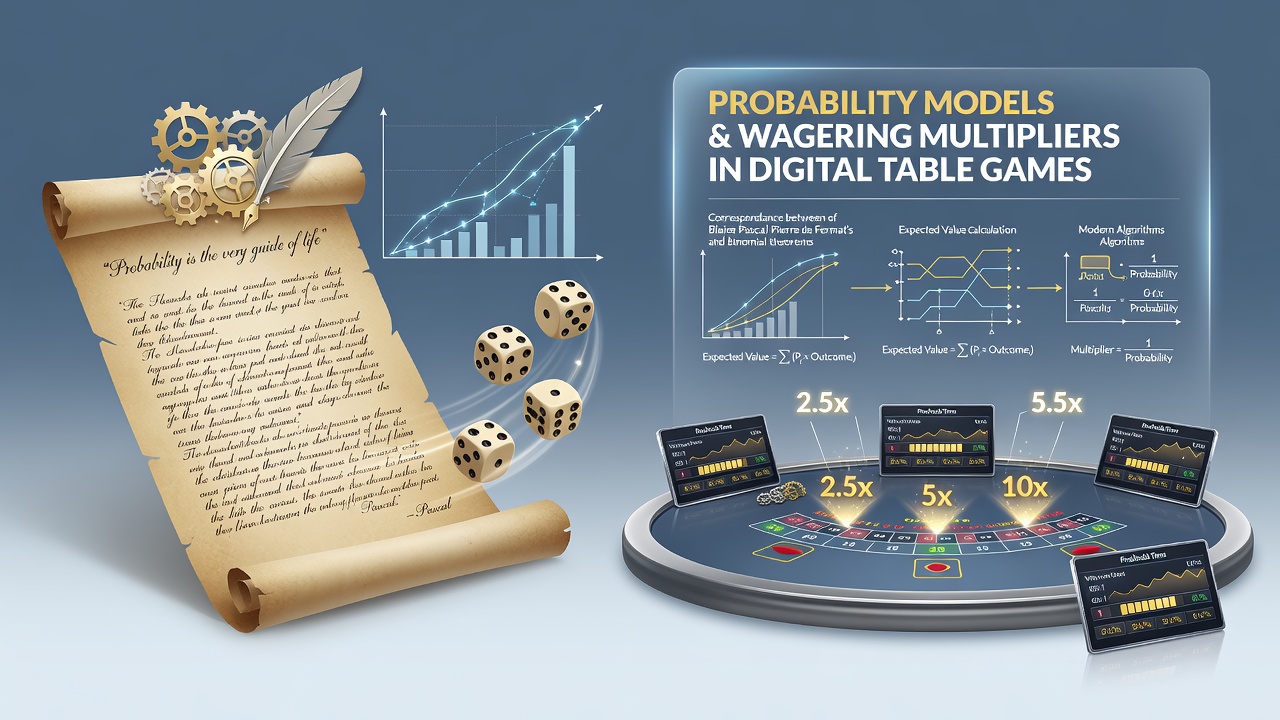
Back in 1654 Blaise Pascal and Pierre de Fermat traded a series of letters that tackled the unfinished game of points, a puzzle about dividing stakes when play stops midway through a match, and those exchanges produced the first systematic treatment of mathematical expectation that still underpins payout calculations in today's digital table games. Observers note the correspondence began when a French nobleman posed the question to Pascal, who then reached out to Fermat for help solving how remaining rounds should affect the final split of wagers, and together they outlined rules for assigning probabilities to each possible outcome based on remaining chances rather than past results alone.
The Core Problem They Solved
The problem centered on two players locked in a contest to reach a fixed number of points, yet external circumstances halted the match before either had finished, which left the question of how to divide the pot fairly, and Pascal approached the issue by listing every remaining sequence of wins while Fermat focused on counting favorable paths to victory. Researchers later confirmed their separate methods yielded identical answers, a development that replaced earlier reliance on intuition with repeatable arithmetic that accounted for every branch of possibility. Data from historical analyses show the letters contained explicit calculations for scenarios involving best-of-three or best-of-five formats, and those formulas introduced the concept of expected value that operators now embed in software governing online roulette wheels, blackjack hands, and baccarat shoes.
From Letters to Lasting Formulas
Within months the two mathematicians refined their approach into general statements about dividing uncertain payoffs, statements that later writers expanded into the law of large numbers and the central limit theorem, yet the original letters already contained the practical insight that each possible continuation carries a precise fractional weight. Studies of the correspondence archive reveal Pascal introduced the idea of imaginary games played out to completion while Fermat used combinatorial counting, and both techniques survive in the random-number generators that digital platforms use to determine multiplier values before any cards are dealt or wheels spun. Figures from academic reviews indicate these early models reduced disputes over interrupted wagers by replacing custom agreements with transparent ratios, a shift that parallels today's regulatory demand for verifiable return-to-player percentages published by licensing bodies.
Application in Modern Digital Multipliers
Software engineers translate the same expected-value logic into wagering multipliers by calculating the long-run average return across millions of simulated rounds, then adjust payout tables so the house retains its built-in edge while players see advertised multipliers that reflect those probabilities. One study released by Canadian regulatory analysts in 2025 documented how online blackjack variants set side-bet multipliers using binomial distributions first explored in the Pascal-Fermat letters, and the same distributions determine progressive jackpot contributions in digital baccarat. As of June 2026 several North American platforms updated their multiplier tables after independent audits confirmed the underlying random sequences matched theoretical frequencies derived from seventeenth-century counting methods.
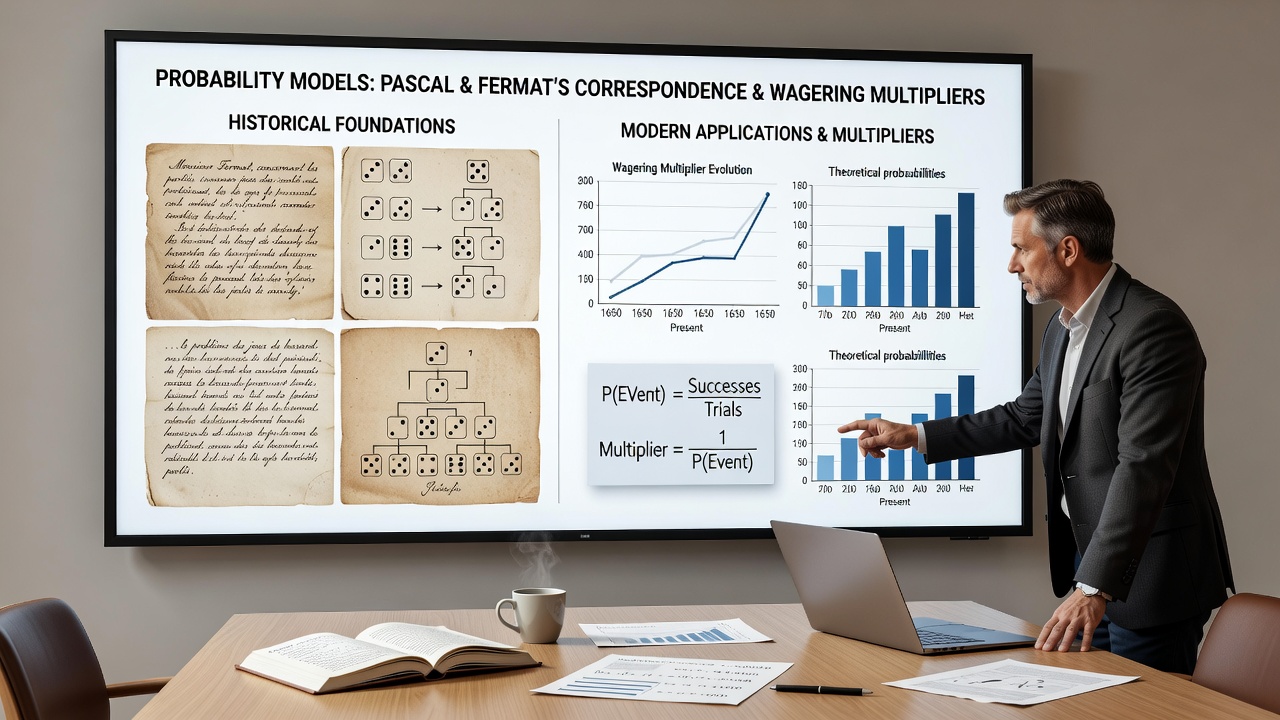
Engineers program the multipliers by assigning each card or wheel segment its exact probability, then multiply those fractions by the offered payout to produce the contribution each outcome makes to overall return, and regulators require public disclosure of those figures so players can compare games across jurisdictions. The Australian Communications and Media Authority has published technical standards that explicitly reference combinatorial methods traceable to the 1654 letters when certifying new table-game releases, while the Nevada Gaming Control Board maintains similar verification protocols for any multiplier change submitted by licensed operators. Those who've examined source code note that random-number generators first shuffle virtual decks according to uniform distributions before applying the weighted multipliers, a two-step process that preserves the fairness assumptions Pascal and Fermat established.
Regulatory and Industry Impact
Industry reports from the European Gaming and Betting Association indicate that verification labs now run billions of simulated hands monthly to confirm multiplier accuracy, and any deviation beyond accepted tolerance triggers software patches before public release. Observers point out that the original correspondence supplied not only the mathematics but also the ethical framework for transparent division of risk, principles echoed in current licensing conditions that demand clear display of return percentages. Data released by the South African National Gambling Board in early 2026 showed that platforms using verified probability engines experienced fewer player disputes over unexpected multiplier outcomes compared with earlier unregulated versions. Researchers continue to map Pascal and Fermat's branching diagrams onto modern decision trees that optimize bonus structures while maintaining house-edge targets set by statute.
Conclusion
The 1654 letters established a durable method for quantifying uncertainty that operators still apply when programming payout multipliers for digital table games, and regulatory agencies around the world continue to reference those foundational calculations during certification. Continued refinement of simulation techniques ensures that every advertised multiplier rests on the same combinatorial logic first worked out centuries ago, while public reporting requirements keep the underlying probabilities visible to anyone who chooses to examine them.