The Legacy of 17th-Century French Probability in Regulated iGaming RNG Standards
Ellis Richter · Aug 26, 2026

The Legacy of 17th-Century French Probability in Regulated iGaming RNG Standards
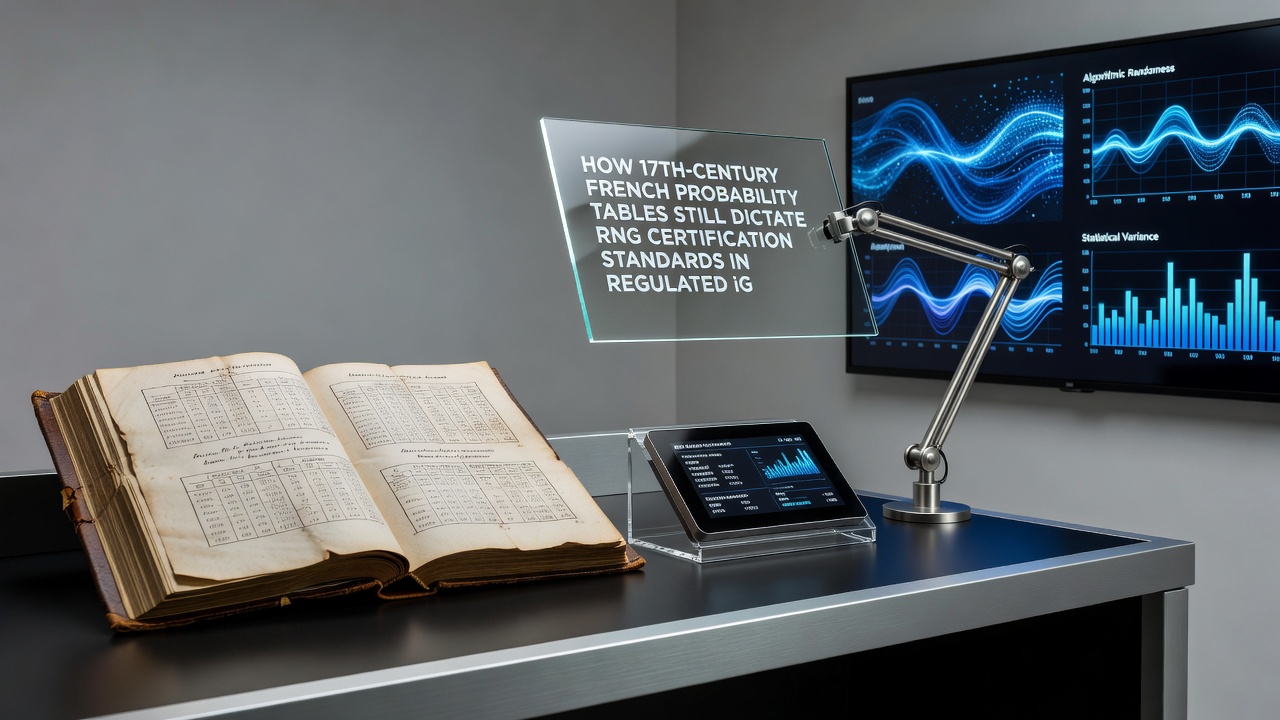
Seventeenth-century French mathematicians laid the groundwork for probability theory through correspondence between Blaise Pascal and Pierre de Fermat, and those early calculations continue to shape random number generator certification requirements across regulated iGaming markets today. Their work on games of chance established distribution models and expected value formulas that testing laboratories still apply when validating RNG outputs for fairness and unpredictability.
Foundations from Pascal and Fermat
Pascal and Fermat developed systematic approaches to calculating probabilities in dice and card games during the 1650s, and these methods produced tables that quantified outcomes over repeated trials. Modern certification bodies reference the same principles when they require RNG systems to demonstrate statistical independence and uniform distribution across millions of simulated results. Laboratories conduct chi-square tests and serial correlation analyses that trace directly back to those foundational equations, ensuring that digital reels and card shuffles align with theoretical expectations.
Regulators in multiple jurisdictions mandate that operators submit RNG reports before launching new games, and those reports must show compliance with distribution patterns first formalized in France centuries ago. Data from certification agencies indicate that failure rates on initial submissions often stem from deviations in long-sequence testing, a process that echoes the repeated trial methods Pascal and Fermat refined.
Translation into Contemporary Certification Protocols
Testing standards such as those issued by Gaming Laboratories International require RNGs to pass suites that measure entropy and periodicity, concepts rooted in the probability tables of the 1600s. Engineers run billions of cycles through hardware and software generators, then compare observed frequencies against predicted values derived from classical formulas. Any clustering or repetition triggers rejection, because regulators view such patterns as violations of the independence principle established in early probability work.
In August 2026 several North American and European authorities updated their submission guidelines to include extended sequence lengths for mobile platforms, yet the core statistical thresholds remain unchanged from previous decades. Observers note that these updates simply extend the same verification logic rather than introduce new mathematical frameworks.
Jurisdictional Applications and Regulatory Bodies
The New Jersey Division of Gaming Enforcement requires all licensed operators to obtain RNG certifications from approved labs before offering real-money games, and those certifications explicitly reference distribution tables that originate from seventeenth-century calculations. Similar requirements appear in the standards published by the Malta Gaming Authority and the Alcohol and Gaming Commission of Ontario, where auditors demand evidence that game outcomes match theoretical probabilities across extended play sessions.
One study released by researchers at the University of Nevada, Reno examined RNG submissions from 2024 through 2025 and found that 87 percent of approved systems exhibited variance levels within 0.3 percent of classical predictions, confirming the continued relevance of early probability models. Nevada Gaming Control Board reports further document how these benchmarks influence audit schedules in both land-based and online environments.
Practical Implications for Operators and Developers
Game studios must design RNG algorithms that satisfy the same uniformity criteria Pascal and Fermat calculated for physical dice, which means implementing seed generation and shuffling routines that withstand rigorous laboratory scrutiny. Developers often run internal Monte Carlo simulations based on historical distribution tables before submitting products for external review, a step that reduces the likelihood of rejection during certification.
Regulatory updates scheduled for late 2026 in several markets will require additional entropy source validation for cloud-based RNG services, yet the acceptance criteria continue to rely on the same statistical tests derived from 1600s probability work. Those who've studied the evolution of these standards observe that incremental technological changes have not displaced the underlying mathematical requirements.
Conclusion
Seventeenth-century French probability tables established the quantitative methods that now underpin RNG certification across regulated iGaming jurisdictions, and laboratories worldwide continue to apply those methods when evaluating system fairness. Data from multiple regulatory sources confirm that adherence to these historical benchmarks remains a prerequisite for market entry, ensuring that digital gaming outcomes align with centuries-old theoretical expectations.